
Veröffentlichungen

Nach Erscheinungsjahr...
| 2016-2018 | 2019-2021 | 2022-2024 | 2025 |
| 2004-2006 | 2007-2009 | 2010-2012 | 2013-2015 |
| bis 1990 | 1991-1995 | 1996-2000 | 2001-2003 |
... oder nutzen Sie die
Neueste Veröffentlichungen
The size of critical secondary nuclei of polymer crystals does not depend on supersaturation
Yang Liu, Zhiqi Wang, Yao Zhang, Tianyu Wu, Tianze Zheng, Bao Hua Guo, Günter Reiter, Jun Xu. Nature Communications 16 (2025) 3773
It is still a great challenge to determine the size of critical nuclei, which is crucial for a comprehensive understanding of crystallization and for testing the controversial crystallization theories. Here, we propose a method to determine the size of critical secondary nuclei on growth faces of poly(butylene succinate) single crystals in solution, basing on the probability of statistically selecting crystallizable units in random copolymers. In a dilute solution and for a given crystallization temperature, we reveal that the size of critical secondary nuclei was independent of supersaturation, contrary to the well-accepted prediction of existing theories which expect that the size of the critical nucleus increases with decreasing supersaturation. Accounting correctly for the dilution-caused change in the steady-state concentration of clusters of various sizes, we remedy inconsistencies of existing theoretical approaches in deriving the correct size of critical secondary nuclei in solution being independent of supersaturation. (more...)
Binghua Wang, Hailong Zou, Xuchen Wang, Changyu Shen, Jingbo Chen, Günter Reiter, Bin Zhang. Nature Communications 16 (2025) 3275
The dissolution of polymer crystals often proceeds at rates varying in time and space. Here, using low molecular weight poly(ethylene oxide) as a model polymer, we exploit step-wise selective dissolution for unveiling how spatial variations in metastability are generated during the growth of lamellar polymer single crystals. The dissolution velocity along defined crystal faces is constant, but ca. 5 times faster for rough than for smooth faces. From the temperature dependence of dissolution, we derive detachment energies of 420 ± 40 kJ/mol and 650 ± 50 kJ/mol for rough and smooth faces, respectively, suggesting that on a rough face polymer chains have ca. 1/3 less neighboring molecules to interact with. The observed high values of the activation energy indicate that, for dissolving a polymer crystal, the progressive detachment of whole chains is indispensable. Our study reveals a strong relation between growth kinetics and the resulting metastability of polymer crystals. (more...)
Baode Zhang, Snežana D. Zarić, Sonja S. Zrilić, Iosif Gofman, Barbara Heck, Günter Reiter. Communications Chemistry 8 (2025) 21
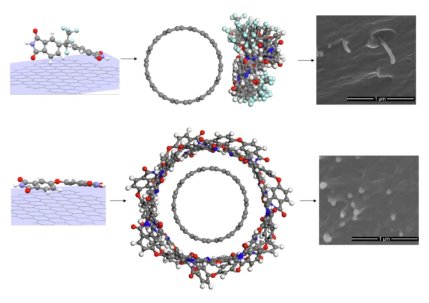 The interplay between attractive London dispersion forces and steric effects due to repulsive forces resulting from the Pauli principle often determines the geometry and stability of nanostructures. Aromatic polyimides (PI) and carbon nanotubes (CNT) were chosen as building blocks as two components in the hetero delocalized electron nanostructures. Two PIs, having the same diamine part and different linkage substituents between two phenyl rings of dianhydride part, one linked with ether bond (C-O-C) (OPI), the other with C-(CF3)2 (FPI), were investigated. Surprisingly, two CNT/PI nanocomposites show distinct failure mode from CNT yielding to CNT pull-out failure. Calculation of the interaction energy and chain conformations of each PI upon CNT was performed by accurate density functional theory (DFT) calculations and molecular dynamic simulation (MDS). (more...)
Valentina Pirela, Leire Unanue, Justine Elgoyhen, Javier Ramos, Juan Francisco Vega, Agurtzane Mugica, Manuela Zubitur, Cuong Minh Quoc Le, Abraham Chemtob, Radmila Tomovska, Günter Reiter, Jaime Martín, Alejandro J. Müller. European Polymer Journal (2025) 113721
This work studies how the chemical structure of relatively similar high-sulfur alternating polythioether homopolymers (DMDS-alt-DVE, DMDS-alt-TEGDVE, and DMDS-alt-BDDVE) affects their structural properties, morphology, polymorphism, and crystallization kinetics. Differential scanning calorimetry (DSC) and polarized light optical microscopy (PLOM) experiments revealed a complex crystallization for the samples in which up to three different polymorphic phases were identified: a very low melting crystal form (VL-Tm form), a low melting crystal form (L-Tm form) and a high melting crystal form (H-Tm form), characterized by their corresponding melting temperature ranges and confirmed via Wide-Angle X-ray Scattering (WAXS). A coexistence of negative and positive spherulites was found, and their origin was revealed by atomic force microscopy (AFM), which showed how the lamellar arrangement varied in the samples from predominantly radial to a cross-hatched morphology. (more...)
Liste der Veröffentlichungen
- Block formation during polymer crystallization
- T. Hippler, S. Jiang, G. Strobl. Macromolecules 38, 9396 (2005)
- Crystallization of a poly(ethylene-co-octene): I - A precursor structure and two competing mechanisms
- Andreas Häfele, Barbara Heck, Takahiko Kawai, Peter Kohn, Gert Strobl. Eur. Phys. J. E 16, 207-216 (2005)
- A thermodynamic multiphase scheme treating polymer crystallization and melting
- G. Strobl. Eur. Phys. J. E 18, 295-309 (2005)
- Crystallization of poly(ethylene-co-octene): II - Melt memory effects on first order kinetics
- Andreas Häfele, Barbara Heck, Thomas Hippler, Takahiko Kawai, Peter Kohn, Gert Strobl. Eur. Phys. J. E 16, 217-224 (2005)
- Dewetting on Model Surfaces: Transition from a Capillary Force Dominated to a Dissipation Dominated Regime
- Günter Reiter, Moustafa Hamieh, Nancy Baudelet, Séverine Sclavons, Pascal Damman. http://www.e-polymers.org (2004)
- Morphogenesis and non-equilibrium pattern formation in two-dimensional polymer crystallization
- Jens-Uwe Sommer and Günter Reiter. Phase Transition 77, 703-745 (2004)
- Nanoparticle ring formation in evaporating micron-size droplets
- Leonid V. Govor, Günter Reiter, Gottfried H. Bauer, Jürgen Parisi. Appl. Phys. Lett. 84, 4774-4776 (2004)
- Self-assembled nanoparticle deposits formed at the contact line of evaporating micrometer-size droplets
- Leonid V. Govor, Günter Reiter, Jürgen Parisi, and Gottfried H. Bauer. Phys. Rev. E 69, 061609 (2004)
- Biocide squirting from an elastomeric tri-layer film
- Philippe Sonntag, Pierre Hoerner, André Chemoyl, Gilles Argy, Gérard Riess, Günter Reiter. Nature Materials 3, 311-315 (2004)
- Controlled melting of individual, nano-meter-sized, polymer crystals confined in a block copolymer mesostructure
- Cvetelin Vasilev, Harry Heinzelmann, Günter Reiter. Journal of Polymer Science Part B: Polymer Physics Volume 42, 1312 – 1320 (2004)
- Crystallization mechanism of syndiotactic polypropylene analyzed by time-dependent light scattering
- T. Kawai, G. Strobl. Macromolecules 37, 2249-2255 (2004)
- The stress relaxation behavior of isotactic poly(1-butene) and its ethylene copolymers
- M. Al-Hussein M, G. Strobl. Journal of Polymer Science, Part B Polymer Physics 42, 2074-2080 (2004)
- Continuous changes in the inner order of the crystalline lamellae during isothermal crystallization of poly(is an element of-caprolactone)
- Kohn P, Strobl G. Macromolucules 37, 6823-6826 (2004)
- Interplay between domain microstructure and nematic order in liquid crystalline/isotropic block copolymers
- R. Ivanova, R. Staneva, S. Geppert, B. Heck, B. Walter, W. Gronski, B. Stühn. Coll. Polym. Science 282, 810-824 (2004)
- Nematic and Smectic Surface Order in the Isotropic-Phase of Low Molar-Mass and Polymeric Liquid-Crystals
- S. Immerschitt, H. Elben, H. Holthoff, G. Strobl. Berichte der Bunsen-Gesellschaft - Physical Chemistry Chemical Physics 98, 376-382 (1994)
- Model treatment of tensile deformation of semicrystalline polymers: Static elastic moduli and creep parameters derived for a sample of polyethylene
- Ke Hong, Ankur Rastogi, Gert Strobl. Macromolecules 37, 10174-10179 (2004)
- Equations describing lamellar structure parameters and melting points of polyethylene-co-(butene/octene)s
- Tai-Yon Cho, Barbara Heck, Gert Strobl. Coll. Polym. Science 282, 825-832 (2004)
- A model treating tensile deformation of semi-crystalline polymers: Quasi-static stress-strain relationship and viscous stress determined for a sample of polyethylene
- K. Hong, A. Rastogi and G. Strobl. Macromolecules 37, 10165 (2004)
- Crystallization of s-polypropylene: a qualitative change in the kinetics induced by the temperature of the melt
- Barbara Heck, Gert Strobl. Coll. Polym. Science 282, 511-513 (2004)
- Summary and conclusions: Progress in our understanding of instabilities in thin films
- G. Reiter. Eur. Phys. J. E, 12, 465 –468 (2003)